Showing posts with label #collegefootball. Show all posts

Sunday, March 30, 2014

WP Poll

In response to the National Labor Relations Board decision allowing Northwestern football players to unionize, the Washington Post asked their readers what they thought about the implications. Below are the three questions in relation to unionizing and paying college athletes:


These questions are short, succinct, and to the point; not bad. With that said, I have a few comments.


First; 44% of the people who responded are not fans of college sports. That is a lot of people commenting on something they do not like. In addition, at the Washington Post you can filter the results to see what different ‘types’ of people think of the question such as 64% of the people whose education included graduate studies support college sports versus 34% do not. I assume this tells us that if you spent 6+ years in college you are more willing to be a fan of college sports (but graduate graduates are not that numerous).


Second; the opinion on unionization was evenly split, 47% to 47%. Before I saw the results I assumed more people would oppose unionization but I was wrong. With that said when you look at the numbers divided by party affiliation 62% of democrats and 28% of republicans support unionization as expected.


Finally; according to the poll, 64% of adults oppose paying salaries to college athletes beyond scholarships. I find the wording of the question biased, “beyond any scholarships they receive” implying that college athletes are already get paid. I know that according to economists, many of the services that these athletes receive is considered ‘pay’; I discussed this in my previous article, Respectfully Disagree. So it makes sense that people oppose paying salaries to college athletes, but would they keep their position if they knew player take home pay was between $2-18k each semester even if their program raked in $109,400,688?


So is it a good poll? Sure. Is it scientific? No; polls rarely are. What did we learn from this poll besides the obvious? Well, it seems most people oppose paying college athletes and the people who do not want to change the status quo are citing this and other polls to support their position.


Supporters of the status quo always talk about college athletes as if they were all the same but they are not, there is a huge difference between how the University of Arizona's tennis and basketball teams are treated on- and off-campus. Unionization of college athletics is not about tennis, soccer, water polo, lacrosse, or the like, it is about men’s football and basketball, and women’s basketball.


Since the Washington Post poll seems to focus on dividing up data, I would like two things to happen that would make both democrats and republicans happy; (1) allow football and basketball players to unionize, and (2) allow market forces to guide big-time college sports. Do this and big-time college sports will be completely different; what you see on ESPN's game day will look almost exactly the same but what happens on and off campus during the season and how much players and coaches would be compensated would be completely different.

Saturday, January 18, 2014

Big Time College Football: An Addendum

I am a happy blogger; I wrote 16 articles about big time college football starting in September and am ending my series with this addendum just after the season ended. The articles I wrote range in length from 230 words to the longest at over 1000 words with a grand total of somewhere around 8700 words; not bad.


After all of these letters, words, sentences, and paragraphs, what have I learned about big time college football? Well, I did not really answer any of the original questions from my original article but my inquiries (I won’t call it research) took me a different direction.


I learned that big time college sports, BCS Football and important I-A basketball teams make a lot of money. Besides BCS teams, most football programs throughout the country do not make much money and mainly break even (some are in the red) but the biggest and highest profile programs make millions.


I learned that big time college football is extremely important at certain schools while at others it is not. Large state research institutions usually have big time college football while private, ‘elite’ institutions vary.


I also learned that there are many articles calling for college football to change and many are calling for it to pro; including me. But I also learned that there are numerous voices, many within the status quo that do not want any type of change and justify the current system in a variety of different ways.

So what next? My next research project is going to be on higher education budgets and I am excited to see where that will lead me; but what about big time college football? Just the same old stuff and unfortunately, from what I have found, nothing will change. Florida State will try to defend their championship, the same teams will be continue to be in the top ten, another Heisman winner will have to wait a year to go pro, and the new playoff system, which is a long time coming, will solve all the controversies still outstanding in college football.

Saturday, January 11, 2014

Big Time College Football: Cutting Athletics (except football)

Cuts, cuts, and more cuts. As I stated in my previous articles #budgetrealities and physics in Maine, programs and now athletics are being cut. In a brief article at Inside Higher Ed and at the official announcement, Temple University is going to cut seven intercollegiate athletic programs as of July 1, 2014. This will reduce the number of varsity sports programs from 24 to 17, which is in-line with other schools in The American Athletic Conference.


These cuts at Temple to me are logical and are following the ongoing trend in higher education because the reality is that schools cannot be everything to everyone anymore. It seems that back in the day, ten to forty years ago, many institutions (larger state and private) were trying to provide everything; offer every type of degree, have every sport, and be a one stop shop for their students. Today, because of funding realities, state and private institutions have to change and many of them are hedging their bets on high profile sports such as football and basketball while keeping other relatively popular sports.


Why keep football and basketball? They make money, and lots of it. According to the Equity in Athletics Data Analysis Cutting Tool, during the 2011-2012 season Temple’s football program made $16,961,995 with a profit of $0 (zero). Their basketball team made $4,080,845 with a profit of $0 (zero). Considering there are no accounting standards when it comes to reporting revenue to the DOE every school reports their revenues differently. To put these lax accounting into perspective, of the institutions that played I-A football during the 2011-2012 season; 28% reported a profit of $0 (zero), 66% reported a profit ranging from $17,339 to $79.9 million, and 6% reported a loss.


Back to Temple hedging their bets on football and basketball; no matter how much you like or dislike big time college sports, it is here to stay and ESPN and the conference specific networks prove it. How often do you see highlights of Temple’s golf, soccer, or volleyball teams on ESPN? Once a season? How often do you see highlights of the football or basketball team? Once a week from September to March even if they field mediocre teams and because of the revenue sharing structure of conferences, Temple will profit off University of Central Florida and Louisville’s stellar 2012-2013 football season even though they went 2-10.


Temple is also in a unique situation to profit off a good football program. They are the only I-A football team in the Philadelphia area and currently play their home games at Lincoln Financial Field (home of the Philadelphia Eagles) by paying a $1 million a year rental fee. Although $1 million a year seems high it is cheaper than building a new stadium somewhere in the Philadelphia metro area for around $55 to $155 million (or more).


The only problem with this is that Temple has to transform their football program into a truly competitive program. They will need to match the University of Louisville’s spending to at least $23 million a year and start competing for recruits with non-AAC programs like Penn State, Duke, Pittsburgh, Maryland, and Boston College. To do this they will need the financial backing of the institution, the support of the president and board of directors, and hire a coach that will take them to the next level (and cost a pretty penny).

It will be interesting to see if Temple can bolster their football program over the next few years while finding ‘efficiencies’ in other parts of the university to help with the year to year budget. But the reality is that the PR that football and basketball generates for a university is huge and unfortunately solid academics, good research facilities, or a champion field hockey team rarely makes-up the difference. Moving forward, colleges and universities have to make hard decisions and cut specific degrees, programs, initiatives, outreach activities, and sports programs while also at the same time allocating more money for other higher profile programs such as STEM fields, business, and football and basketball.

Friday, December 27, 2013

Big Time College Football: Respectfully Disagree Part II

In my ongoing search for articles about college football and the possible transition to a professional collegiate league, I recently came across an article at ESPN titled the Myth of Parity. Below are my favorite quotes from the article with my humble responses.


“Yes, for the most part, colleges and universities are making money off of the backs, performances and success of major football and men's basketball programs and the scholarship athletes who play them. But ask yourself: Isn't that what most businesses do?”


Because businesses make money off the backs of its employees, it is okay that the NCAA does the same thing. In this country, businesses pay their employees a reasonable wage depending on the industry, employee experience, tenure (how long they have been there), and a variety of other factors. Some companies pay a decent wage while others, like WalMart, employ a large number of workers that make under $25k a year (there is nothing illegal about it). So with that logic, it is okay that the NCAA, along with the colleges and universities that field these players, make millions off these young adults (like big shareholders at WalMart) while these talented young players make thousands (I guess the NCAA is like WalMart).


The lesson to be learned here is make as much money off the backs of talented collegiate athletes, keep the best possible profit margin, and never change.


“The problem seems to be that we don't look at college athletics as a business. Instead, we subconsciously and constantly (and emotionally) look at college sports as something different. We allow the "school" part to blind us into thinking that the educational piece changes the dynamics of what is really going on and exempts athletics from being about something other than money. It's not. But that's our fault, not the NCAA's.”


I am not really sure who does not look at college athletics as a business, but for anyone who has watched a BCS football game or a I-A basketball game it is big business. With that said, if your are watching a lacrosse game, swimming, or golf, those sports are not about business and are/should-be about student learning (Tiger Woods dropped out of Stanford after two-years; why would be have stayed?). I do agree that people do have an emotional response to sports and this changes how people perceive what is going on on and off the court. But I do disagree that this is all our fault and not the fault of the NCAA’s; the NCAA is responsible for every action it has made and every marketing dollar it has spent in the name of hyping big time college sports.


“We need to stop looking for fairness in this because there is none and there never will be. There are very few businesses that are fair across the board to the people who work for them.”


I know life is not fair; I, like most people learned that lesson a long time ago. It just seems funny that this author is using the ‘life is not fair, so why try?’ argument in his article.


“No one is making kids go to school to make money for the colleges and universities. They and their families choose to do this. It is an agreement that is not set up to pay them in ways that is fair in relation to the money the schools make from their participation. It's rather like taking an unpaid internship to prepare for a better job later in life. It is a trade-off. An unfair one, but it is consensual.”


I agree; players who play for Alabama or Auburn enter a consensual relationship. But, they enter this consensual relationship because they have no other options. There is no minor league for football or basketball players to enter at age 18 unlike baseball, hockey, or soccer. If an 18 year old football player wants to be ‘seen’ he has to go to college and he has to agree to this consensual relationship (18 year olds do not head north and play for the CFL) because he hopes that by working hard he will eventually make the NFL a few years later. For many if they get a degree that is great, but most BCS scholarship players don’t care because it gets in the way of their number one job; playing football.


As an aside, I guess after reading these articles by Dorfman and Jackson I am a little disappointed. These are good writers with good careers, who have influential pulpits, with one loud and clear message; don’t change anything, the current systems works, and these athletes are doing fine (even though nothing is fair).

Friday, December 20, 2013

Big Time College Football: Implementation of the NCAA Pro-League

Now that I have gone over the different aspects of my proposed NCAA Pro-League, when can it be implemented?


Well; it will be a while. ESPN has a contract with the NCAA worth bi$$ions to televise college playoffs from 2014-2025 so most likely nothing will change until 2025. In 2025 the following will have to happen:
- The NCAA will have to give up their football and basketball monopoly;
- A new portion of the NCAA, the NCAA Pro-League would take up the professional responsibilities;
- 32 plus colleges and universities will have to drastically change how they operate football on their campuses;
- 32 plus new NCAA Pro-League football teams will have to be formed with admin staff and the like;
- New media agreements will have to be made;
- Lots of contracts will be signed;
- The NFL would have to be 100% on-board.


So do we really have to wait for the 2026 season for this to be implemented? Yes unless the government gets involved. I would highly recommend the NCAA and the top I-A teams get together and form the NCAA Pro-League, or something equivalent, because if they don’t and the government legislates change then all bets are off on what the end result will be.

But at the end of day, will anything actually change? I fear not. For some reason it seems that colleges and universities will continue to get away with paying college players a few $housand$ while the NCAA, the programs, and the important people in-charge will continue to get paid mi$$ions.

Friday, December 13, 2013

Big Time College Football: Consequences of an NCAA Pro-League

Every decision, every action, and every well thought-out plan has known and unknown consequences. If the NCAA started transitioning some of the I-A football and basketball programs to my proposed NCAA Pro-League there would consequences, and not all of them would be positive.  

Existing Conferences
The new NCAA Football Pro-League will likely keep many, if not all of the existing major conferences. There is no reason to eliminate the AAS, ACC, BIG-10, BIG-12, PAC-12, or SEC when those can be the divisions in the new league. Like the NFL with its two conferences and eight divisions, the NCAA Pro-League can have two conferences and six to ten divisions (depending on how things would be divided). By keeping all of the conferences, the rich history and fan loyalty will be easily transferred to the Pro-League.

Competition
With the NCAA Football Pro-League competition would start in week one. Pro-League teams would not be able to play lower division teams because that would require professional athletes to play amateure athletes, something the NCAA would not allow. With the season starting in week one we would no longer see blowouts as I highlighted in my previous article Competitive? and teams like Georgia would not play New Mexico State or Coastal Carolina anymore.

Playoff System and Bowl Games
The NCAA Football Pro-League could implement a robust playoff system that would include many of the bowl games that are currently running. During the 2011-2012 academic year there were 35 bowl games and 5 all-star games. If the NCAA Pro-League copied the NFL playoff format exactly it could use 11 of the 35 bowl games with the rest used for the I-A division (non-professional). The NCAA-Pro League would also reduce the number of all-star games to one (the all-star game could use one of the bowl games such as...the Hawaii Bowl).

Ownership
An NCAA Pro-League team would need to be majority owned by its cooperating academic institution with minority owners. This would be needed because it would get messy if Iowa State’s owners wanted to move the team somewhere else because the city of Ames and Iowa State did not want to go halfsies on a stadium. The team’s name, identity, brand, and history would be exclusive to the locality so in case a team wanted to get up and leave, a school would not lose their 100-years of history because of the whim of an owner like Al Davis.

Stadiums
What to do about stadiums? What will the city of Ames, Auburn, Gainesville, Tempe, et cetera do about teams wanting new stadiums? They will pretty much do what they are doing today; ask the public to pay for a portion, ask alumni to pay for a portion, and then bankroll the rest as team debt. Texas A&M, from what it seems, has done a great job of asking their alumni to donate millions to renovate Kyle Field so why not make that the norm?

Relegation and Promotion?
Not really relegation and promotion, but there would need to be a process for teams in I-A to prepare and eventually transition to the NCAA Pro-League. Example; if Boise State was not able to make the jump initially they could prepare for several years by raising money, creating a business plan, work on agreements, and set-up a transition plan to be able to become professional when the time is right.

On the flip side if a team was in the NCAA Pro-League and wanted to jump back down to I-A football there would have to be a contingency plan allowing for that. Besides the ownership and money aspects, the athletes would go from being professional to student athletes with all the rules of the NCAA applying. Most of the players who were playing for the team would probably leave requiring the new I-A version of the team to recruit all new players and new coaches.

Bankruptcy
One serious consequence of an NCAA Pro-League would be bankruptcy by individual teams. Because the NCAA Pro-League teams would be outside the control of their cooperating institutions, they could go bankrupt if badly mismanaged. Recently, say the last few decades, the NFL has had zero bankruptcies with most bankruptcies being in hockey or occasionally baseball. This is a testament to the popularity of football and the need to have well managed teams that are financially secure.

Opting Out
Some big name schools might opt to not be part of the NCAA Pro-League signing separate deals with networks creating competition between the NCAA Pro-League and I-A (such as Notre Dame). Since the NCAA would be ‘in-charge’ of I-A and be a majority partner in the Pro-League this scenario would hopefully be avoided but could still work if all parties negotiated for the best possible outcome.

Another scenario of opting out is some of the big name schools might not want to be part of the NCAA Pro-League. Schools such as BYU, Boston College, Duke, and Vanderbilt might decide to not be in the Pro-League. This would be a win-win because it would mean that there would be history and competition not only in the Pro-League but also in I-A. Unfortunately for the schools in I-A there would be less money to go around but by being in the NCAA and not the NCAA Pro-League these schools would be publically acknowledging that as institutions of higher education their core missions are to educate their students and not field football teams.

Friday, December 6, 2013

Big Time College Football: Eligibility and Academics of the NCAA Pro-League

So far I have focused on the money part of big time college football and the formation of my proposed NCAA Pro-League. Next, I will look at eligibility and the higher education aspects of this professional collegiate-level league.


Players will have four years of eligibility in the NCAA Pro-League; there will be no ‘redshirting’ since players will be paid to play. Age eligibility will be 18 to 30 with some exceptions depending on the situation (on the high end, not low). Being on the practice squad will count as part of the four years of eligibility. A high school diploma or GED will be required.


The logic of continuing to have four years of eligibility in the NCAA Pro-League is to limit the duration athletes stay in the league. Like the current system, athletes put in their four years and move on. If there was no limit to how many years a player could play in the NCAA Pro-League it would become the NFL on Saturday with players playing their entire careers at the University of Georgia.


Next, every player who signs a contract for one of the NCAA Pro-League teams will have the option to enroll part-time at the cooperating or an affiliated  institutions. Why part-time? Because the current system of academics works for athletes like Robert Griffin III and his reported academic prowess but the majority of athletes struggle to keep up with their studies while playing big time college football. For those who want to attend college part-time there would be no GPA minimum; you do not want to penalize those who actually want to get an education while playing for big time programs. Ideally, players would take online courses in the fall and take brick and mortar courses during the spring of summer (for the obvious reasons). For those institutions who do not join the Pro-League; nothing would change concerning academic requirements.


The majority of athletes who would sign NCAA Pro-League contracts would be young adults; between 18-24. In the span of four short months these players would go from graduating high school to making more money than their parents. Because of this there would be two mandatory requirements during each year of eligibility; financial planning and a college savings account.


Mandatory financial planning. Each player would be required to take six-credits of financial planning each year or two, three-credit courses. These courses would range from money basics in year one to how to successfully protect and invest your money in the NFL in year four. The idea is to help these young adults successfully manage their money rather than blowing it during their four years of eligibility. At the end of the four years of eligibility, a player could have up to 24 credits of finance/accounting/financial planning credits that could be used when getting their college degree. These credits could be realized by the cooperating institution recognizing those credits, CLEP, competency based credits, et cetera.


Mandatory college savings account. Each player will be required to set-up a college savings account. Like a 401k, Pro-League athletes will be required to save for college so if they complete four years of eligibility and do not make the NFL, they will have money to attend college. Ideally it would be set-up like a 401k where the teams would match the players savings up to a certain percentage. Example: if a player makes $200,000 a years for four-years and saves 10% of his income with the team matching 3% and the market returning 4%, this player will have around $95,000 in their college savings account. If they do not make the NFL and use it for college at the University of Georgia most if not all of their costs would be covered and they would graduate debt free. If they do make the NFL or do not want to use it for college they can cash it out with a penalty.


Finally, the academics at the cooperating institutions. Again, using University of Georgia as the example, the only thing the president would have to worry about every year would be signing a contract with the NCAA Pro-League team(s). After the university decides on how much it will cost the football team to use the name of the institution and facilities (stadium, et cetera), the president would be able to focus on higher education issue because football operations would be outside the university. With that said if Georgia wins the national championship the president can still attend and relish in the accomplishment with the whole country watching and the University of Georgia brand being broadcasted everywhere, especially ESPN. But if a scandal broke-out it would be handled by the CEO of the University of Georgia Pro-League football team, not the president of the university.


To summarize; the NCAA Pro-League allows allows players at big time college football programs to do what they are already doing, play football and try to make the NFL. It also allows them to get paid to play, attend college part-time during their eligibility, and requires them to learn about financial planning and save money for future college attendance.Finally, it allows colleges and universities to be in the business of educating adults while divesting themselves of the day to day operations of big time college football.

Wednesday, December 4, 2013

Big Time College Football: Respectfully Disagree

In an article for Forbes, Jeffrey Dorfman argues that college athletics should not go professional and gives many good reasons backed up by economic logic. I understand the point of view of the author but I have to respectfully disagree.


To start off, he states that athletes “receive free tuition, room, meal plans, and some money for books and miscellaneous expenses. At the bigger, more successful universities, athletes also receive academic counseling, tutoring, life skill training, and even nutritional advice.” In addition, they also received “free professional coaching, strength and fitness training, and support from athletic trainers and physical therapists.” He estimates that these goods and services vary between $50k to $125k per year, depending on the school, and according to economists, any goods and services is considered pay.


I agree; but.


First, I question what he means by ‘more successful universities’ in this statement. Does he mean Alabama which won three of the last four BCS Championships; or does he mean the Southwestern Athletic Conference that had a seven point bump or the Mid-Eastern Athletic Conference that had a one point bump in their Adjusted Graduation Gap three-year average while the SEC has a negative eighteen? I assume he is talking about BCS wins versus how many football players graduate.


Next, the author asks what about Title IX? Title IX is a legitimate concern and if college athletics or even a few selected sports turned professional under the umbrella of individual higher education institutions Title IX would create serious complications. With my proposed NCAA Pro-League individual professional teams would not receive any Title IX funding because they would be separate from their cooperating institutions so Title IX would be off the table. All other sports still under the control of the University of Georgia for example (except the programs that would go pro like football) would still have to abide by the rules set by Title IX.


The author then discusses a salary cap and “if there is a cap, then the best players may still be ‘exploited’ in the same sense that some people think they are being exploited now.” I agree that the best players would still be exploited because athletics exploit players at every level of competition but should rampant exploitation continue just because that’s how it has always been? To start off, college football makes a lot of money, and I mean a lot more money than it used to make one generation ago. Next, individual programs make a lot of money. Staying in the SEC, the University of Georgia made over $77 million during the 2011-2012 season in which they went 10-4, lost the SEC Championship game and the Outback Bowl to Michigan State, and were ranked #19 at the end of the season; not bad. Currently, players earn what I describe as a pittance, between $4k to $18k in actual take home pay, not including benefits and services. If young football players were making between $100k to $300k per year playing for the University of Georgia in the NCAA Pro-League I don’t think they would mind being ‘exploited’ because they are getting paid to play. It is hard to legitimize and defend a system where the University of Georgia made $77 million in one season while the take-home pay for all football players was less than Mark Richt’s salary.


At the end of the article, the author states again that the majority, or 90% of college athletics loses money. I agree that most programs do lose money and it would be difficult creating professional leagues, but there are people, and more than a handful, calling for professional college level athletics for sports like football and basketball. I don’t think anyone is expecting the NCAA to create professional indoor track and field, golf, or equestrian leagues.


The NCAA, the BCS, and I-A basketball need to do the right thing for themselves and their players and go pro. Create the NCAA Pro-League and let the free market be ‘free’ rather than having the NCAA and all of the ‘successful’ programs make bi$$ions while individual athletes make $housands.


Addendum.
In the comments section the author points out that basketball players can also go pro in Europe and China and football players can go to Canada. I find this funny because the other major North American sports; baseball, ice hockey, and soccer all have viable minor leagues in the US but for football and basketball, the NCAA is the minor league. The CFL has and never will cut out the BCS; a young player will still play four years at Georgia and then move up to Canada to play football if needed. Europe and China will never cut out NCAA I-A basketball; a young player will still play four years at Georgia and then move to Italy to play for an Italian team if needed. Using this argument is not valid.


Finally the author makes a comment about the free market and the number of sports at colleges and universities. I do agree that with the new budget realities the market is going to start cutting many different sports and athletic programs all around the country. But to call the NCAA and what colleges and universities do a free market is humorous.

Tuesday, November 26, 2013

Big Time College Football: Revenue Criteria and Salary Cap


Designing a professional college football league would require a lot of changes to the current system (to put it mildly). I will first go over revenue criteria, salary cap, and average player salary of my proposed NCAA Football Pro-League. .


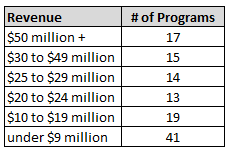
What will the minimum revenue  threshold be for the new NCAA Football Pro-League? Using the he Equity in Athletics Data Analysis Cutting Tool, the following chart shows how many I-A programs fell within the following revenue ranges during the 2011-2012 academic school year/season:


Should the new league have 32 teams with a minimum revenue threshold of $30 million; 48 teams with a minimum revenue of $25 million; or 60 teams with the minimum revenue threshold set at $20 million?


For my proposed NCAA Football Pro-League, the minimum revenue threshold should be set at $30 million. Below are the top benefits of a $30 million minimum:
1. There are 32 NFL teams and initially the NCAA Football Pro-League would have 32 teams; nice parallel.
2. $30 million in revenue is nothing to laugh at. Most teams that have $30 million in revenue have large fan bases that reach beyond their localities.
3. $30 million in revenue allows for a solid salary cap.


Because so many changes would be needed to form the Pro-League, a $30 million minimum would just be a start. After the initial 32 teams are set, additional teams would be able to work towards meeting the minimums (not just revenue) allowing the league to slowly grow over time. The league might eventually reach 48 or even 60 teams as long as each team is financially solid and can conduct football operations in the black. The minimum revenue threshold would also be adjusted each year to account for inflation.


Next, the NCAA Football Pro-League would require a salary cap. The NFL salary cap in 2011 was $120 million and using the revenue of the bottom four teams as a guide, 50% of their revenue went to player’s salaries. Using the NFL as the precedent and with the minimum revenue threshold at $30 million, this would allow for a $15 million salary cap (simple but effective). Rosters would also be reduced from the current blotation of up to 120 players to the NFL norm of 75 including the practice squad.


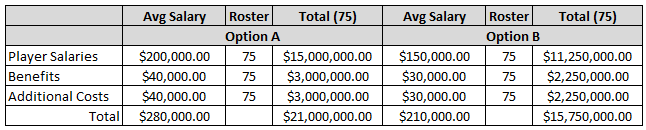
The following chart shows how much salary and benefits would cost an NCAA Football Pro-League team if the salary cap was set at $15 million. Option A is a team that meets the salary cap exactly at $15 million and Option B is a team that is at 75% of the salary cap. I included how much normal employment benefits and additional player costs would add to the salary.


At team like Ohio State, which made in $58.1 million during the 2011-2012 could easily go with Option A because after paying player salaries, benefits, and additional costs Ohio State would still have $37.1 million left. A team like Georgia Tech, which made $32.1 million would go with Option B because after playing player salaries, benefits, and additional costs Georgia Tech would have $16.35 million left versus $11.1 million with Option A. That additional $5.25 million for a team like Georgia Tech would pay for the all the coaches salaries and allow them to operate in the black rather than the red.

With the minimum revenue criteria and salary cap established we can look at how much players will be making. The minimum salary for an NFL rookie in 2011-2012 was $375,000. If the NCAA Football Pro-League has salaries that vary between options A and B, the salary range would be between $100,000 to $300,000, or between 30% to 60% of an NFL rookie. A player on the practice squad could bring in $100k while a highly recruited high school phenom could make $300k. This would allow a player like Johnny Manziel, A.J. MaCarron, or even Ka’Deem Carey to make $300,000 a year rather than around $18k according to one source (high end).